
Thunder-Pumper
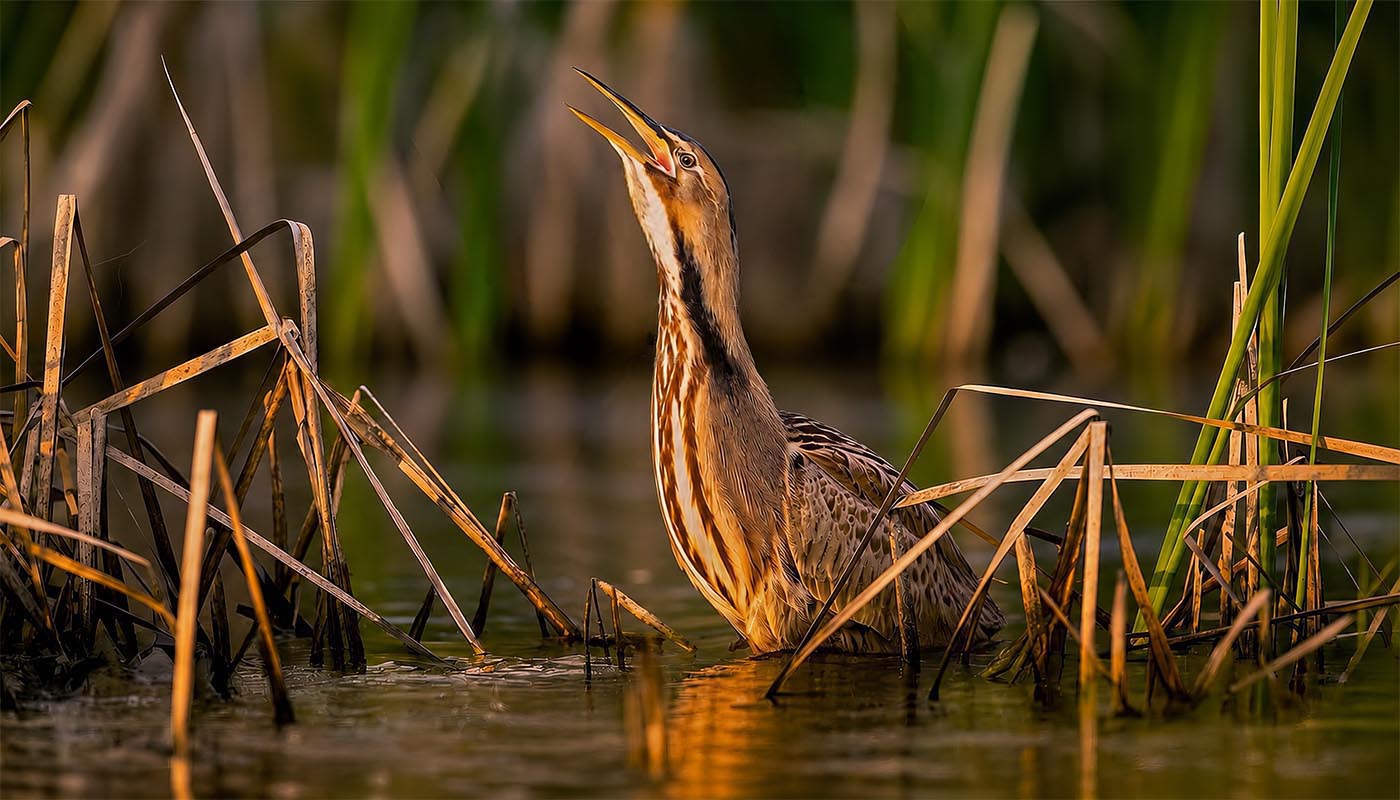 American Bittern. 17 May 1993, 6am, Lake Louise, next to Chase Lake National Wildlife Refuge near Woodworth, North Dakota. Recorded by Lang Elliott. Image AI-gen.
 Note: The recording featured here is a "3D binaural soundscape". Please wear headphones for a profound listening experience that will make you think you're actually out there, immersed in the natural world!
It is dawn in a vast prairie wetland in central North Dakota. I sit quietly in my canoe, alongside a dense stand of cattails and rushes. The marsh is alive with bird sounds, but I am here specifically to record the resonant, gulping onk-ka-chonk (or pumper-lunk) of an American Bittern (also known as “thunder-pumper” or “water-belcher”)—hidden in thick vegetation less than a hundred feet away.
The bittern’s bizarre mating call rings out over the marsh as if he were the soloist in the marsh’s grand orchestra of sound. How fortunate to be here now, but where exactly am I? And how on earth did I get to this very spot, scarcely a stone’s throw from the maestro’s lair?
The story begins the day before. While exploring the Missouri Coteau prairie pothole region in North Dakota, I discover Lake Louise, an expansive marshy wetland that is a wellspring of natural sounds. At dusk, the soundscape borders on being cacophonous, but what interests me most is the hollow, resonant call of an American Bittern, which sounds off occasionally in the distance. I’m disappointed … I want a close and clean recording of the bittern’s call, but he’s very far away in an inaccessible part of the marsh. I’m not sure I will be able to home in on him, but a little voice inside says “It never hurts to try.”
So, at around 3am, under dim moonlight, I paddle my canoe into a maze of shallow channels and patches of cattails and rushes, trying to thread my way across the marsh to the bittern’s location. Sometimes I lose my bearings and have to wait many minutes before he vocalizes again. Finally, after nearly two hours of frustrating dead ends, I find myself next to his hideout in a marshy thicket.
I quietly creep forward in my canoe until I am just a stone’s throw away. I dare not make much noise or I’ll flush him. Barely daring to breathe, I carefully place my soundscape mic on my tripod and then lower it into shallow water. I attach my recorder to the top of the tripod, hit record, and then retreat just far enough away that the bittern will not see me when daylight arrives.
My strategy works. At first light, the bittern bursts into action, calling about every thirty seconds, while numerous other marsh birds sound off in the background. I am elated! It has been a long and frustrating night—but worth every wrong turn! Against all odds, I have somehow managed to capture the bittern’s extraordinary onk-ka-chunk for all the world to hear!
Listen for the following species in the background: Marsh Wren, Gadwall, Shoveler, Sora, Western Grebe, Pied-billed Grebe, Willet, Yellow-headed Blackbird, Killdeer, Willet, Ring-billed Gull, and more!
Dear Listeners: Please take a moment to chime-in and let me know what you think of this recording.

 Friends ... if you find that my posts have a positive impact on your life, please help support my effort by making a modest donation.
Donate Now
Comment Section
 Dear Readers: Would you like to have your picture show up next to your comment, rather than an empty silhouette? Click here to learn how.



Greetings I loved hearing this. I only heard the American bittern once and I had to look it up after I’d heard it but it actually frightened me. I was by myself at the Cape Cape Cod in ( North Truro) and I was near Marshland and heard the dunk a dunk con dunk a dunk sounds so loud ( it must have been a few feet from me!!!), it scared me!, and then I realized what I was hearing, having listened to several Bird recordings in my life, it was magnificent and I’ve returned many times over the years,… Read more »
That’s a beautiful recording, Lang. I like the periodic nature of the bittern’s song and all the other birds filling in the intervals. I’ve heard the bittern’s call at a nearby marsh and I is very impressive. Thanks for sharing. I hope there is just as many calls and songs in the marsh now as there was in 1993. I had a heavy Coleman Scanoe back then but now have a feather light kayak and it sure is easier to load, unload, and lug around.
Thanks Lang – I really enjoyed hearing this – I had only heard from a distance in the Adirondacks. I wonder if the liquid clicking sounds before the major pumping sounds are breath intake? Just for fun, I turned my phone to merlin and it could identify the marsh wren, blue-winged teal, redhead and redwing but didn’t seem to notice the bittern – untrained I guess! Thanks again, Ruth
I absolutely love this! What a great return for your work!
What a gorgeous recoding! (My cat,Nikos, is intrigued – he’s looking out my back window and around my little studio to find the origin of that sound)
Another EXCELLENT capture, Lang! Had to be difficult juggling all your sound equipment trying to not lose it and keep it dry. All while trying not to spook your target. Every little metallic bump is so magnified at night on the water.
Wonderful. I want to be there. Thank you.
I also want to be there Lizzy. It was an incredible location, the Missouri Couteau region, chockfull of prairie pothole lakes and ponds that all drain into a huge underground aquifer that flows westward and ends up in the Missouri River. The wetlands are teaming with life; there’s simply nothing like here in the East. But it’s such a long haul to get out there. I’m not sure I have it in me to do another long cross-country jaunt.
Hope all is well with you, Let’s catch up on things via email!
This recording is amazing! I haven’t had the privilege of ever hearing one in the wild but hope to. Thanks for sharing. I’m curious if it’s the same recording as the one you used in “A Guide To Night Sounds” The bittern sounds precisely the same, but this recording on my computer provides a lot of extra background sound even at at the quiet areas. Also, that guide was older and I heard it first on cassette tape.
Yes, it is indeed the same recording, though presented here as recorded binaurally (stereo). The recordings in A Guide to Night Sounds were all monaural. At times I’ve considered doing a new revision of the original guide that would be 100% binaural, with recordings accessed via QR codes. I have tons of great recordings that would not only replace many of those featured in the original guide, but would add a number of new species as well. But dealing with the artwork would be a huge project, unless, of course, I could use AI to generate images. The original guide… Read more »
I remember the drawings. I hate AI but if it helps you generate new content, why not. I listened to that guide until I wore out two cassette tapes and then found it on CD.
Thanks again for everything!
Yes, Ben, I have the same cassette! It introduced me to Lang’s work probably 30 years ago!
Same here.
And it gave me a love for night/nature sounds that turned into more and more. People now send me recordings of stuff and ask me what it is. Love it! (:
Lang, this is a wonderful track. Many sounds are beautiful; this one is that and magical, as well. Nicely done. Hats off to the performer!
Thank you!
Hi Lang—I always enjoy your incredible recordings, but want to express my strong belief that these AI-generated images are in poor taste. Is there some barrier to using actual photography of the real natural world, as taken by a human? Considering that your recordings are essentially acoustic ecology, assigning AI images to them seriously besmirches the integrity of the thing. These “photos” aren’t nature; rather, they’re approximations of nature calculated by a profit-driven computer. Additionally, AI data center operations are having extraordinarily severe tolls on the natural environment, the likes are which are easily researchable if you’re unaware of them… Read more »
Points well taken. My reason is that it’s been difficult enough for me to get great recordings and I simply never had the time or resources to get great photos of everything as well. So that means I either have to purchase photos (via Shutterstock, iStock Photo and the like), get them from friends, or else use AI, or use no photo at all. And given that I cannot afford to purchase photos and I don’t want to bother photographer friends for free use of their images, that leaves AI. What’s more, AI allows me to craft images of night… Read more »
I understand your concern with AI but also agree with you it’s the best answer.
Lang, an extraordinary recording by the master that takes me THERE!
Love the eastern marsh wren 🙂
Thank you for a fine listen
Thank you Don. It is definitely a great recording and I worked hard for it. Of course, back then I had a lot more brute energy than I have now. And that was a 70 pound Grumman aluminum canoe which I would simply toss on top of my old full size Chevy Van as if it were no heavier than a hay bale. How on earth did I manage that?