
Beaver Moans and Cave Drip
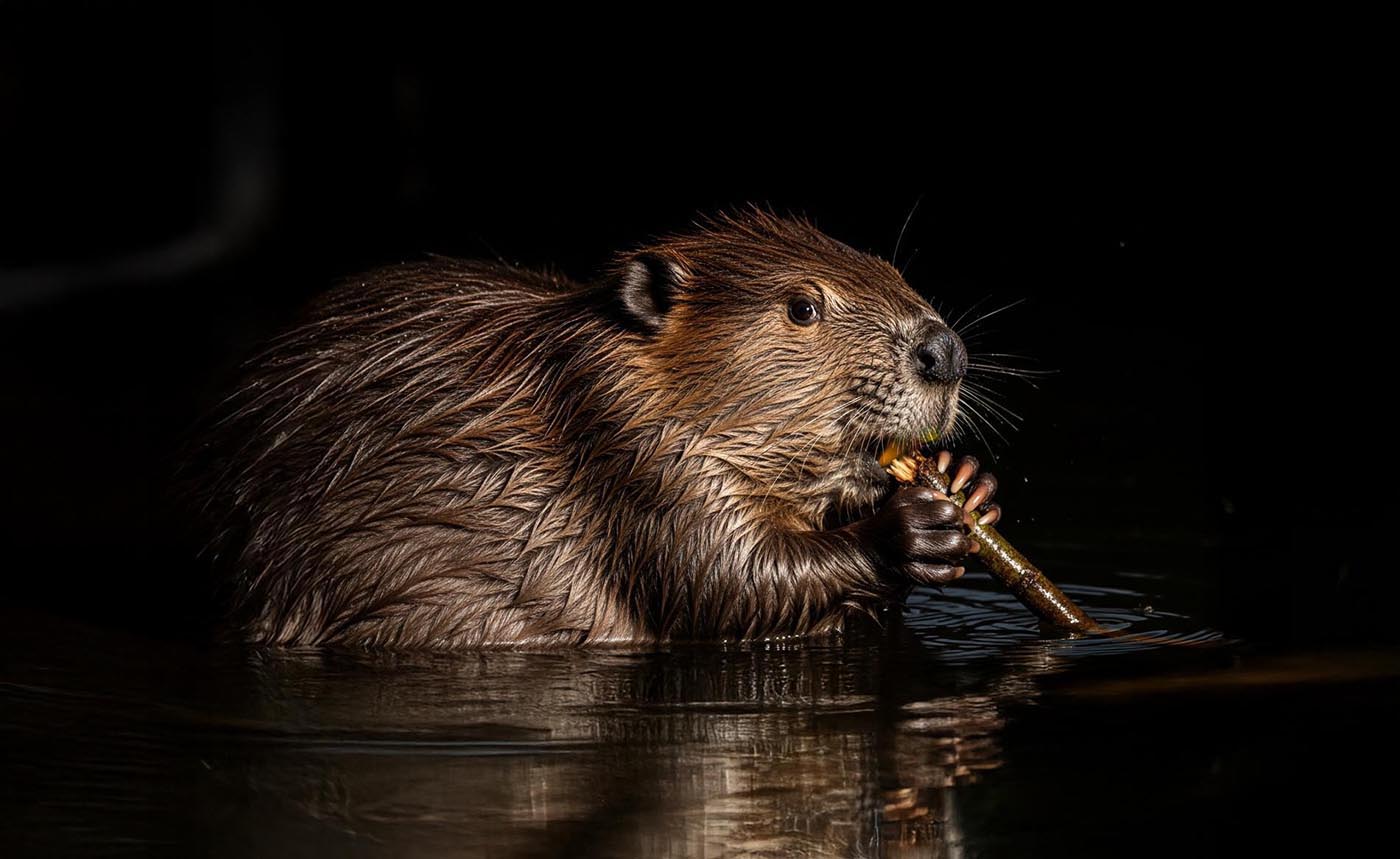
Beaver Moaning and Cave Drip. 9 May 2024, 11pm. Round Spring State Park north of Eminence, Missouri. AI-gen image.
 Note: The recording featured above is a "3D binaural soundscape". Please wear headphones for a profound listening experience that will make you think you're actually out there, immersed in the natural world!
In the Ozark region of southern Missouri, Round Spring wells up into a large sinkhole, surrounded by steep forested slopes on all sides. The water is a vivid blue and flows out through a cavelike passageway at one end, emerging about a hundred feet away to form the headwaters of a large creek that meanders a short distance before flowing into the Current River.

Round Spring during the day. The exit passageway is on the left.
With some effort, I am able to place my microphone a few feet into the cave, where drips from the ceiling make resounding plops, plinks, and snaps as they strike water and stones below. I record the dripping sounds for several hours. Then, at 11pm, something unexpected happens ... I suddenly hear mournful moans and whines, and later chewing sounds, given by two American Beaver.
What a delight! Earlier in the day, I had seen beavers swimming in the creek below. with one heading upstream and disappearing into the cave. Apparently, the beavers have a den inside the passageway, or at least a bed of tree stems and small limbs from which they feed.
Reflections:
This is one of my favorite soundscapes. I love the resonant acoustics of the cave drip, and the moans and sweet whines of the beavers are quite endearing. I actually recorded the entire night. The beavers sounded off on a number of occasions, but the segment featured above is by far the most compelling.
At one point, one individual swam right up to my mic and then slapped his tail loudly against the water—KERSPLASH!—his telltale alarm reaction. I doubt that the beaver could see my mic in the pitch-black darkness. More likely, he smelled it and that was enough to cause alarm. I'm just glad he didn't knock my very expensive recording setup into the water.
Some of you may think that with all the moans and whines, the beaver are sad or otherwise disturbed—simply because in human terms those sounds would be associated with such emotions. But I disagree. I've had a lot of experiences recording beavers and they generally make these sounds while feeding or while hanging around their den, seemingly undisturbed. So, I believe what you hear in my recording are actually "happy sounds," made by contented beavers. My guess is the low moans are made by an adult, while the higher whines are from a youngster of the year. If any of you disagree with this assessment, please chime-in.
More Information:
Round Spring is a circular pool about a hundred feet across and 55 feet deep. The water flow is enormous—about 26 million gallons per day! The cavelike passageway is nearly twenty feet wide, but only two feet high at the entrance. I wouldn't dare try to swim through because there could be obstructions along the way, and it might be next to impossible to swim back against the strong current.

Naturally Yours,

 Friends ... if you find that my feature articles have a positive impact on your life, please help support my effort by making a modest donation.
Donate Now
Comment Section
 Dear Readers: Would you like to have your picture show up next to your comment, rather than an empty silhouette? Click here to learn how.



I love those springs of the Ozark Plateau! Such a wonderful addition to hear this recording, thanks!
And thanks too for your clear responses to the folks concerned about AI images. Clenching our fists and hearts against all AI use is overly reactionary; what’s useful (and necessary) is transparency, which you’ve offered. After a lifetime as a naturalist, I totally trust you to know whether the search for photos is coming up with what you need.
Thanks for chiming-in Jim, and I trust you are doing well? I’m now almost 78 years old and I’ve been grappling with some major health issues, but I’m still stumbling along, still recording soundscapes, and hope to spend a lot of time this coming spring and summer gathering nature immersion videos with accompanying binaural sound.
p.s. I think Christine Hass told me that you two met up briefly in 2024, either before or after she and I did some recording in the northern prairie states. Or does my memory fail me?
We should perhaps talk more via email? I’d love to hear about your current adventures.
This is great recording! Love the sounds of the Beavers. I have been listening to your recordings for a long time now, I have your app, and think you really capture amazing stuff. However, I do have to agree with some of the other posts that using an AI image paired with your wonderful organic sounds is perplexing. I don’t know how I feel about AI in the long run, but in this case, since you work so hard at capturing these sounds, which is a very organic pursuit, an AI image does seem to undercut that authenticity a bit.… Read more »
Thank you for your feedback. I wish I had a good solution. You see, the problem is that I want photos that illustrate the content and mood of a recording. In a small number of cases, I have such photos. But in the vast majority of cases (95% or more of the time), I do not have l suitable photos. So what should I do? I’m 77 and facing aging problems and there is no longer time for me to go back out there and try to gather hundreds or even thousands of photos to illustrate my best recordings (the… Read more »
Thanks for comment Lang. I have personally done work in non-fiction documentary so I know all about the time suck that is searching for the right photo. It almost never is right! So I completely understand your reasoning. And maybe you have something about photos generally expected to reflect reality. It’s tricky! I wonder if you did a survey about this, would more people be accepting of the AI image, or would more people say ‘don’t do it’? Would more people want a compromised photo than an AI one? Or would an AI painting be acceptable. Or perhaps those of… Read more »
Well, to be truthful, I will be making good use of ai in the near future because I will be expanding my mobile app considerably over the next couple of years, and ai is proving to be a lifesaver in this respect. Coming up with photos for the initial version was so time-consuming and exhausting that I finally ran out of energy and decided not to keep expanding the app. But now I can generate really powerful images and the amount of work involved is reasonably acceptable. So I’m off and running with the app expansion. And what a relief… Read more »
Great to know about app expansion. Look forward to it! And thank you for all these amazing posts you do. Your recordings always make my day!
I was glad to read your commentary about the presumed ‘sad’ sounds we are hearing that are not that at all. We tend to anthropomorphize often and attribute our own meaning to sights and sounds in nature. I was disappointed to read that the image of the beaver was Ai generated though. Keeping with the natural theme of your site I’d much rather see a real photo – a more consistent message.
I only wish I could get my own superb photos of night scenes that would do justice to my wonderful night-time soundscape recordings. But I can’t even find such photos in professional stock photo agencies. And even if I could find them, I wouldn’t be able to afford paying for them, especially for profitless uses such as for my blog posts. So it boils down to choosing between 1) using an inappropriate photo (eg. a daytime photo of a beaver for the sake of showing the species), 2) using no photo at all, or 3) using an ai generated image… Read more »
I can help, and glad to. https://www.facebook.com/joe.taylor.5496683
Thanks for the offer Joe. I have discovered that ai does a poor job of depicting nightjars in night scenes. Might you have any photos of Common Poorwills or Mexican \Whip-poor-wills? Silhouetted, perched, and preferably singing? Daytime photos of nightjars are fairly common, but night photos are far rarer, except some that that are lit frontally by flash.
Actually, I just tried again using Google’s Image FX and I think I maybe got a keeper, to accompany a great recording I made of a Poorwill in a desert setting. Where earth would I find an actual photo depicting this scene of a poorwill singing at night in the Southwest, silhouetted by dull light after sunset.
The alternative is to try to find a night photo on the internet or through a stock agency. But the result will probably look like the attached, which is a flash portrait from Cornell’s website showing a non-singing bird. I greatly prefer what I just conjured using Image fx … it has more feeling and conveys a sublime mood fitting of my recording.
Hi Lang! Long time. I hear what you’re saying, but as I’m watching/hearing about vast area of nature being steamrolled for AI data centers, and with incredible amounts of fresh water being used to cool them, I’d vote for no image at all rather than AI, or something in with the mood rather than exact. AI is significantly harming the photography and art markets, and it is destroying the natural environments that we’re all trying to sustain.
I hope you’re doing alright with your health.
Don’t have much in regards to birds.
Interesting as I didn’t know beavers vocalized in that manner.
I have loved beavers and studied to learn about them for years, but this is the first time I have ever heard this kind of vocalizing, and it is enchanting. Thank you so much for this beautiful recording!
This is a beautiful and creative sound recording. Thanks you so much for sharing this. And, I appreciate that you clearly state that the beaver image is AI generated. Nonetheless, I am perplexed and dismayed with the use of an AI generated image. I think it is important in natural history studies to do all we can to adequately and authentically represent the natural world. It does raise questions as to whether or not the sound recording itself is authentic, and how, in the future, we can know what we are listening to.
I’m using ai-generated images because ai is allowing me to create very realistic imagery that is specially-tailored to complement recordings, especially those made at night. I looked for appropriate photos on shutterstock, istockphoto and other online sources and couldn’t find anything I liked. Here’s a question: if I turned it into an ai-generated painting, would you still find it unacceptable? Ny feeling is that if ai can help me produce an image that is strongly resonant with a recording, I will use it but I will be upfront that it is ai generated. That seems a better option than using… Read more »
So cute! This water sounds very tropical to me for some reason. The beaver sounds are just so endearing. Thank you for sharing this!
Lovely. I didn’t think the beavers were sad — just being beavers. What an active conversation. What stories they must be telling!
Very cool! I live in that area and have beavers on my creek but did not know their sounds. Thank you for this.
There was a lot of beaver activity in the stream below, which the spring feeds. And, as I believe I said, I saw a beaver (during the evening before) swim into the passageway from downstream. But I was quite surprised to find them in there calling and chewing. So do they have a den in the cave, or perhaps a feeding bed … I do not know. But there was beaver activity (calling and chewing) periodically through the night (I recorded the entire night). And while it’s technically a “cave,” the waterway is more precisely a “cavelike passageway” leading from… Read more »
Trying once more to attach male beaver courtship mound pix. Not successful earlier
I love this!!! Magical. We are deaf and blind to so many wonders! But thanks to you, you give us ears to hear. What sweet voices they have. I have swum my horse across the Current River near Eminence MO and have seen those beautiful springs. Our beaver males in TN are now building their winter courtship mounds ( my own term) along Beaver Creek to attract their ladies. Took pix just yesterday of the new riverbank beaver mounds. Here is one. Thanks Lang!! Wonderful!
Ah, those sweet-smelling mounds—brings back many pleasant memories from my bygone days living in the Adirondacks, which was (and I trust still is) beaver paradise.
Phenomenal, Lang, unlike anything I’ve heard. I was not aware of beaver vocalizations until now. Well done.
I love the wet echoing background to what sounds like an octave lower than the whoopee sounds squirrels are making in (I’m afraid) my roof these days. Thanks Lang!
So you have Gray Squirrels in your attic?
I’m afraid so. But in this weather I don’t want to ask anyone to climb a ladder to find out or to bump young squirrels out into the single digit weather.
what makes Lang’s captures so powerful, compelling and joyous is much more than the recordings themselves, which are truly magical. Equally important is his extraordinary gift of fieldcraft: knowing where to go, how to go there, how to not intrude on the environment, and how to be respectful of it at all times. These are the things that make his work so very special. Thank you, Lang.
I actually am quite respectful “most” all the time. But there have definitely been a few situations where maybe I went a little too far in my zeal to get a recording. So, I would say that your portrayal of me is probably 95% correct (maybe higher), which isn’t bad if you ask me.
Spot on, Steven. These amazing recordings are the result of hours of hard work requiring stealth and knowledge of not only his equipment but his target soundscape he hopes to capture!!
Amazing. The binaural experience is terrific. It would be so interesting to know what they were doing and what the calls were about. Wonderful recording.
I have a number of recordings of beaver and the sounds you hear are generally made by adults and/or young when feeding. In other words, I believe they are happy sounds. “Moaning and whining” is the primary language of beavers. While we humans might think those are sad or upset sounds, I do not believe they are, at least the vast majority of the time.
A little imperfection just adds to the perfection!
I believe the Japanese call that “Wabi Sabi”.
…Or maybe just ‘wasabi.’
According to google’s AI overview, Wasabi (Eutrema japonicum) is a pungent, green root vegetable native to Japan. But sounds good, I’ll settle for that, especially given that I can be pungent sometimes.
BTW, our replies somehow got attached to the wrong original message, but I guess that doesn’t matter.
No worries. A little humor for a cold Saturday. Enjoy the weekend, Lang!