
Amazon Rainforest Soundscapes
3D Binaural Recordings from Peru and EcuadorAmazon Rainforest Soundscapes
by Lang Elliott
Featuring 165 supremely-immersive lowland rainforest soundscapes gathered in Peru and Ecuador, Amazon Rainforest Soundscapes" blah blah over 15 hours of recordings Night, Dawn, Day and Dusk ... birds, monkeys, frogs and insects galore, along with the elemental sounds of rain and thunder, wind, the gurgle of jungle streams, and the incessant splats of water droplets falling from leaves and limbs high in the canopy.
blah, blah, blah, blah. Lorem ipsum dolor sit amet, consectetur adipiscing elit, sed do eiusmod tempor incididunt ut labore et dolore magna aliqua. Ut enim ad minim veniam, quis nostrud exercitation ullamco laboris nisi ut aliquip ex ea commodo consequat. Duis aute irure dolor in reprehenderit in voluptate velit esse cillum dolore eu fugiat nulla pariatur. Excepteur sint occaecat cupidatat non proident, sunt in culpa qui officia deserunt mollit anim id est laborum.
speaker-friendly "quasi-binaural" recordings (go here for more information, Lorem ipsum dolor sit amet, consectetur adipiscing elit, sed do eiusmod tempor incididunt ut labore et dolore magna aliqua. Ut enim ad minim veniam, quis nostrud exercitation ullamco laboris nisi ut aliquip ex ea commodo consequat. Duis aute irure dolor in reprehenderit in voluptate velit esse cillum dolore eu fugiat nulla pariatur. Excepteur sint occaecat cupidatat non proident, sunt in culpa qui officia deserunt mollit anim id est laborum.
Huge variety of birds are hear in the various soundscapes, including: macaws, parrots, potoo, piha, toucans, tinamous, trogons, thrushes, motmots, pigeons and doves, woodpeckers, woodcreepers, caracara, wrens, cacique, nunbirds, antbirds, oropendola, pauraque, herons, bittern, and owls galore. Mammals include howler and titi monkeys. And gobs of insect songs from crickets, katydids and cicadas. In addition, and solid assortment of earth sounds such as rain, thunder, wind, and the gurgle of jungle brooks. As a bonus, I include a full-length 45-minute thunderstorm and several extended 20-30 minute dawn choruses.

Lorem ipsum dolor sit amet, consectetur adipiscing elit, sed do eiusmod tempor incididunt ut labore et dolore magna aliqua. Ut enim ad minim veniam, quis nostrud exercitation ullamco laboris nisi ut aliquip ex ea commodo consequat. Duis aute irure dolor in reprehenderit in voluptate velit esse cillum dolore eu fugiat nulla pariatur. Excepteur sint occaecat cupidatat non proident, sunt in culpa qui officia deserunt mollit anim id est laborum.
Product Conception
The rationale behind our creation of Wild Voices Extracted is rather simple on the surface, yet is more complex than one might initially surmise.
Nearly all field recordings of particular birds, frogs, insects and mammals contain significant background sounds, quite often the excited songs and calls of other animals in the surroundings, but also the whoosh of wind, the incessant gurgling of nearby streams, distant traffic noise, the rumble of jets, barking dogs, roosters crowing, and the like. As a result, it is often very difficult to add such recordings to ambient beds because the background sounds will be audible (unless kept at a very low level). Not only that, if the source recording is a "monaural sound object" (which is almost always desirable), the background sounds will be tightly bound to the sound object itself.
Thus, at least in the domain of adding specific monaural sound objects to virtual 3D environments, it makes good sense to process field recordings to reduce or eliminate background sounds, thus making it much easier, almost trivial in fact, to add them to surround beds at whatever level is desired. Wild Voices Extracted has quite literally "done this hard work for you," so that you can focus on creativity and not have to wrangle field recordings yourself to make them usable.
When attempting to spatialize nature sound objects, another problem inevitably comes to the fore. And this has to do with "reverberation." Nearly all object-oriented field recordings are reverberant to one degree or the other, and sometimes quite so. For instance, when an owl hoots in the wilds, the "reverberant tail" at the end of the hoot is usually quite obvious. Furthermore, if one listens closely, it is apparent that reverberation "reaches out in all directions." The echo after an owl's hoot occurs across the entire landscape; it is not bound to the owl itself.
The fact is ... reverberation occurs as the hoot radiates out into the environment and reflects off of objects, be they tree trunks, rock formations, or nearby hills. Thus, reverberation is the landscape's response to the hoot and represents a marriage of the hoot that left the owl's beak with the owl's surroundings. From the perspective of the listener, the owl's hoot does not exist all by itself as a singular sound object. Rather, it becomes intertwined with its surroundings, a true expression of the whole.
In light of the above, it should be obvious that reverberation is inherently three-dimensional and does not occur at the same location where the sound object originated. When an owl hoots, the sound object that leaves its beak is virtually free of reverberation. Reverberation occurs as the hoot moves away from its source and interacts with the surroundings. The takeaway is: monaural point-source nature sound objects optimized for placement in 3D surround environments should be dry and non-reverberant. Reverberation should be added during the spatialization process such that the reverb reaches out in all directions, thus giving life to the sound object by "marrying it" to its three-dimensional surroundings.
In conclusion, the editing techniques we have used to create Wild Voices Extracted not only involve the elimination of background sounds, but also require reduction of reverberation to dry-out the sound object and make it more suitable for subsequent spatialization and reverberation in ambient surround beds.

Spatialization Basics
The rationale behind our creation of Wild Voices Extracted is rather simple on the surface, yet is more complex than one might initially surmise.
Nearly all field recordings of particular birds, frogs, insects and mammals contain significant background sounds, quite often the excited songs and calls of other animals in the surroundings, but also the whoosh of wind, the incessant gurgling of nearby streams, distant traffic noise, the rumble of jets, barking dogs, roosters crowing, and the like. As a result, it is often very difficult to add such recordings to ambient beds because the background sounds will be audible (unless kept at a very low level). Not only that, if the source recording is a "monaural sound object" (which is almost always desirable), the background sounds will be tightly bound to the sound object itself.
Thus, at least in the domain of adding specific monaural sound objects to virtual 3D environments, it makes good sense to process field recordings to reduce or eliminate background sounds, thus making it much easier, almost trivial in fact, to add them to surround beds at whatever level is desired. Wild Voices Extracted has quite literally "done this hard work for you," so that you can focus on creativity and not have to wrangle field recordings yourself to make them usable.
When attempting to spatialize nature sound objects, another problem inevitably comes to the fore. And this has to do with "reverberation." Nearly all object-oriented field recordings are reverberant to one degree or the other, and sometimes quite so. For instance, when an owl hoots in the wilds, the "reverberant tail" at the end of the hoot is usually quite obvious. Furthermore, if one listens closely, it is apparent that reverberation "reaches out in all directions." The echo after an owl's hoot occurs across the entire landscape; it is not bound to the owl itself.
The fact is ... reverberation occurs as the hoot radiates out into the environment and reflects off of objects, be they tree trunks, rock formations, or nearby hills. Thus, reverberation is the landscape's response to the hoot and represents a marriage of the hoot that left the owl's beak with the owl's surroundings. From the perspective of the listener, the owl's hoot does not exist all by itself as a singular sound object. Rather, it becomes intertwined with its surroundings, a true expression of the whole.
In light of the above, it should be obvious that reverberation is inherently three-dimensional and does not occur at the same location where the sound object originated. When an owl hoots, the sound object that leaves its beak is virtually free of reverberation. Reverberation occurs as the hoot moves away from its source and interacts with the surroundings. The takeaway is: monaural point-source nature sound objects optimized for placement in 3D surround environments should be dry and non-reverberant. Reverberation should be added during the spatialization process such that the reverb reaches out in all directions, thus giving life to the sound object by "marrying it" to its three-dimensional surroundings.
In conclusion, the editing techniques we have used to create Wild Voices Extracted not only involve the elimination of background sounds, but also require reduction of reverberation to dry-out the sound object and make it more suitable for subsequent spatialization and reverberation in ambient surround beds.
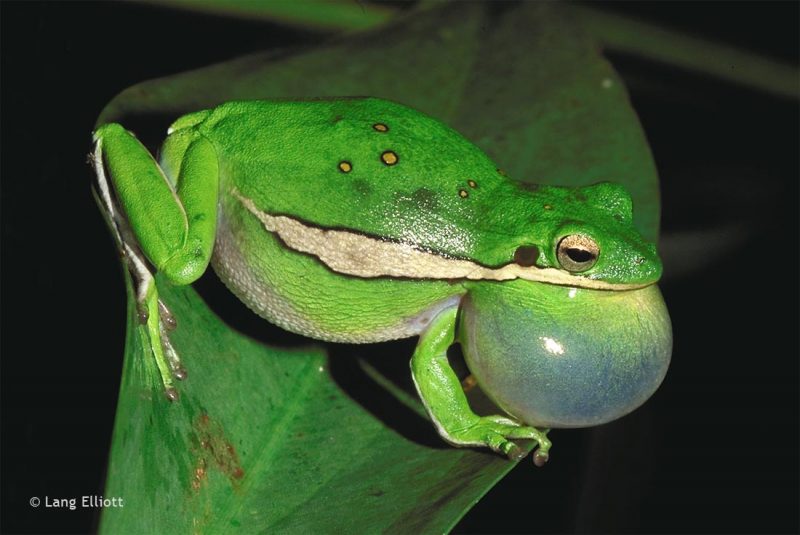
Product Conception:
The rationale behind our creation of Wild Voices Extracted is rather simple on the surface, yet is more complex than one might initially surmise.
Nearly all field recordings of particular birds, frogs, insects and mammals contain significant background sounds, quite often the excited songs and calls of other animals in the surroundings, but also the whoosh of wind, the incessant gurgling of nearby streams, distant traffic noise, the rumble of jets, barking dogs, roosters crowing, and the like. As a result, it is often very difficult to add such recordings to ambient beds because the background sounds will be audible (unless kept at a very low level). Not only that, if the source recording is a "monaural sound object" (which is almost always desirable), the background sounds will be tightly bound to the sound object itself.
Thus, at least in the domain of adding specific monaural sound objects to virtual 3D environments, it makes good sense to process field recordings to reduce or eliminate background sounds, thus making it much easier, almost trivial in fact, to add them to surround beds at whatever level is desired. Wild Voices Extracted has quite literally "done this hard work for you," so that you can focus on creativity and not have to wrangle field recordings yourself to make them usable.
When attempting to spatialize nature sound objects, another problem inevitably comes to the fore. And this has to do with "reverberation." Nearly all object-oriented field recordings are reverberant to one degree or the other, and sometimes quite so. For instance, when an owl hoots in the wilds, the "reverberant tail" at the end of the hoot is usually quite obvious. Furthermore, if one listens closely, it is apparent that reverberation "reaches out in all directions." The echo after an owl's hoot occurs across the entire landscape; it is not bound to the owl itself.
The fact is ... reverberation occurs as the hoot radiates out into the environment and reflects off of objects, be they tree trunks, rock formations, or nearby hills. Thus, reverberation is the landscape's response to the hoot and represents a marriage of the hoot that left the owl's beak with the owl's surroundings. From the perspective of the listener, the owl's hoot does not exist all by itself as a singular sound object. Rather, it becomes intertwined with its surroundings, a true expression of the whole.
In light of the above, it should be obvious that reverberation is inherently three-dimensional and does not occur at the same location where the sound object originated. When an owl hoots, the sound object that leaves its beak is virtually free of reverberation. Reverberation occurs as the hoot moves away from its source and interacts with the surroundings. The takeaway is: monaural point-source nature sound objects optimized for placement in 3D surround environments should be dry and non-reverberant. Reverberation should be added during the spatialization process such that the reverb reaches out in all directions, thus giving life to the sound object by "marrying it" to its three-dimensional surroundings.
In conclusion, the editing techniques we have used to create Wild Voices Extracted not only involve the elimination of background sounds, but also require reduction of reverberation to dry-out the sound object and make it more suitable for subsequent spatialization and reverberation in ambient surround beds.
Product Conception:
The rationale behind our creation of Wild Voices Extracted is rather simple on the surface, yet is more complex than one might initially surmise.
Nearly all field recordings of particular birds, frogs, insects and mammals contain significant background sounds, quite often the excited songs and calls of other animals in the surroundings, but also the whoosh of wind, the incessant gurgling of nearby streams, distant traffic noise, the rumble of jets, barking dogs, roosters crowing, and the like. As a result, it is often very difficult to add such recordings to ambient beds because the background sounds will be audible (unless kept at a very low level). Not only that, if the source recording is a "monaural sound object" (which is almost always desirable), the background sounds will be tightly bound to the sound object itself.
Thus, at least in the domain of adding specific monaural sound objects to virtual 3D environments, it makes good sense to process field recordings to reduce or eliminate background sounds, thus making it much easier, almost trivial in fact, to add them to surround beds at whatever level is desired. Wild Voices Extracted has quite literally "done this hard work for you," so that you can focus on creativity and not have to wrangle field recordings yourself to make them usable.
When attempting to spatialize nature sound objects, another problem inevitably comes to the fore. And this has to do with "reverberation." Nearly all object-oriented field recordings are reverberant to one degree or the other, and sometimes quite so. For instance, when an owl hoots in the wilds, the "reverberant tail" at the end of the hoot is usually quite obvious. Furthermore, if one listens closely, it is apparent that reverberation "reaches out in all directions." The echo after an owl's hoot occurs across the entire landscape; it is not bound to the owl itself.
The fact is ... reverberation occurs as the hoot radiates out into the environment and reflects off of objects, be they tree trunks, rock formations, or nearby hills. Thus, reverberation is the landscape's response to the hoot and represents a marriage of the hoot that left the owl's beak with the owl's surroundings. From the perspective of the listener, the owl's hoot does not exist all by itself as a singular sound object. Rather, it becomes intertwined with its surroundings, a true expression of the whole.
In light of the above, it should be obvious that reverberation is inherently three-dimensional and does not occur at the same location where the sound object originated. When an owl hoots, the sound object that leaves its beak is virtually free of reverberation. Reverberation occurs as the hoot moves away from its source and interacts with the surroundings. The takeaway is: monaural point-source nature sound objects optimized for placement in 3D surround environments should be dry and non-reverberant. Reverberation should be added during the spatialization process such that the reverb reaches out in all directions, thus giving life to the sound object by "marrying it" to its three-dimensional surroundings.
In conclusion, the editing techniques we have used to create Wild Voices Extracted not only involve the elimination of background sounds, but also require reduction of reverberation to dry-out the sound object and make it more suitable for subsequent spatialization and reverberation in ambient surround beds.
Spatialization Basics:
Placement of sound objects in 3D audio environments is fairly straightforward. The main requirement is access to spatialization software, some of which may be platform dependent. For instance, while the popular DearVR Pro spatialization software is adaptable to a variety of surround platforms, other plugins such as the Oculus Spatializer are aimed at specific game development engines such as Unity. In add cases, however, the basic spatialization procedure is the same.
First off ... once a monaural, point-source sound object is selected, it is placed in the three-dimensional sound-field in a particular direction and at a particular distance. HRTFs (head-related transfer functions) and similar processing tricks are used to create the sense that the object is out there in space, and not inside the head of the listener. Volume, of course, must be adjusted accordingly. Note however that spatialization all by itself will not yield a natural-sounding result. Of critical importance is to add reverberation, which (as explained in "Spatialization Basics"), reaches out into space to connect the sound object to its environment.
Great care must be taken when adding reverberation, with attention paid not only to distant reverberation but also to close reflections, especially when sound objects are placed nearby. In most real world applications, however, sound objects such as owl hoots, bird songs, frog calls, and insect chirps are generally placed in the distance for a more ambient, mood-setting background effect. Thus, distant reverberation is typically more important than close reflections.
The amount and quality of the reverberation makes a huge difference and sound designers must experiment to find favorite settings that produce the desired effect. As an example, all of our binaural demonstrations (featured above) were made in Logic Pro using the DearVR Pro spatialization plugin. In most cases, we used the built-in reverberation options offered in the plugin itself and turned off the close reflection option. Only a handful of the reverb "spaces" built directly into DearVR Pro proved useful to us as we strived to produce a natural "outdoor-sounding" result (these were: Medium Recording Hall, Large Recording Hall, King's Hall, Cathedral, and Church).
Many sound designers will of course choose to use their favorite reverb plugins rather than those built into the spatializer software, and this is generally easy to implement. In DearVR Pro, one needs only to turn off the internal reverb section and then add one's chosen reverb plugin into the effects sequence right after spatialization of the sound object. In our own work, we've experimented with using Exponential Audio's Nimbus plugin instead of Dear VR Pro's on-board options, and we were able to achieve very good results. In addition, we tried using outdoor impulse responses (available from Boom Library) in conjunction with the Altiverb convolution plugin, again with satisfying results.
The sky is the limit when it comes to adding reverb. Producing a truly natural-sounding result is key to tricking the listener into believing that the sound-makers (birds, frogs, insects and mammals) are really out there in nature, fully integrated and "married to" the ambient surround bed. Fortunately, the spatialization tools currently at our disposal are remarkable in this respect, and quite capable of producing amazingly realistic results.
Spatialization Basics:
Placement of sound objects in 3D audio environments is fairly straightforward. The main requirement is access to spatialization software, some of which may be platform dependent. For instance, while the popular DearVR Pro spatialization software is adaptable to a variety of surround platforms, other plugins such as the Oculus Spatializer are aimed at specific game development engines such as Unity. In add cases, however, the basic spatialization procedure is the same.
First off ... once a monaural, point-source sound object is selected, it is placed in the three-dimensional sound-field in a particular direction and at a particular distance. HRTFs (head-related transfer functions) and similar processing tricks are used to create the sense that the object is out there in space, and not inside the head of the listener. Volume, of course, must be adjusted accordingly. Note however that spatialization all by itself will not yield a natural-sounding result. Of critical importance is to add reverberation, which (as explained in "Spatialization Basics"), reaches out into space to connect the sound object to its environment.
Great care must be taken when adding reverberation, with attention paid not only to distant reverberation but also to close reflections, especially when sound objects are placed nearby. In most real world applications, however, sound objects such as owl hoots, bird songs, frog calls, and insect chirps are generally placed in the distance for a more ambient, mood-setting background effect. Thus, distant reverberation is typically more important than close reflections.
The amount and quality of the reverberation makes a huge difference and sound designers must experiment to find favorite settings that produce the desired effect. As an example, all of our binaural demonstrations (featured above) were made in Logic Pro using the DearVR Pro spatialization plugin. In most cases, we used the built-in reverberation options offered in the plugin itself and turned off the close reflection option. Only a handful of the reverb "spaces" built directly into DearVR Pro proved useful to us as we strived to produce a natural "outdoor-sounding" result (these were: Medium Recording Hall, Large Recording Hall, King's Hall, Cathedral, and Church).
Many sound designers will of course choose to use their favorite reverb plugins rather than those built into the spatializer software, and this is generally easy to implement. In DearVR Pro, one needs only to turn off the internal reverb section and then add one's chosen reverb plugin into the effects sequence right after spatialization of the sound object. In our own work, we've experimented with using Exponential Audio's Nimbus plugin instead of Dear VR Pro's on-board options, and we were able to achieve very good results. In addition, we tried using outdoor impulse responses (available from Boom Library) in conjunction with the Altiverb convolution plugin, again with satisfying results.
The sky is the limit when it comes to adding reverb. Producing a truly natural-sounding result is key to tricking the listener into believing that the sound-makers (birds, frogs, insects and mammals) are really out there in nature, fully integrated and "married to" the ambient surround bed. Fortunately, the spatialization tools currently at our disposal are remarkable in this respect, and quite capable of producing amazingly realistic results.
In Conclusion:
Thank you for your interest in Wild Voices Extracted. There are currently no other products like this in the marketplace, where nature sound objects have been so painstakingly optimized for spatialization into surround ambient backgrounds. We trust that you will embrace the possibilities and make good use of the work that we’ve done!
Naturally yours,

Product Conception:
The rationale behind our creation of Wild Voices Extracted is rather simple on the surface, yet is more complex than one might initially surmise.
Nearly all field recordings of particular birds, frogs, insects and mammals contain significant background sounds, quite often the excited songs and calls of other animals in the surroundings, but also the whoosh of wind, the incessant gurgling of nearby streams, distant traffic noise, the rumble of jets, barking dogs, roosters crowing, and the like. As a result, it is often very difficult to add such recordings to ambient beds because the background sounds will be audible (unless kept at a very low level). Not only that, if the source recording is a "monaural sound object" (which is almost always desirable), the background sounds will be tightly bound to the sound object itself.
Thus, at least in the domain of adding specific monaural sound objects to virtual 3D environments, it makes good sense to process field recordings to reduce or eliminate background sounds, thus making it much easier, almost trivial in fact, to add them to surround beds at whatever level is desired. Wild Voices Extracted has quite literally "done this hard work for you," so that you can focus on creativity and not have to wrangle field recordings yourself to make them usable.
When attempting to spatialize nature sound objects, another problem inevitably comes to the fore. And this has to do with "reverberation." Nearly all object-oriented field recordings are reverberant to one degree or the other, and sometimes quite so. For instance, when an owl hoots in the wilds, the "reverberant tail" at the end of the hoot is usually quite obvious. Furthermore, if one listens closely, it is apparent that reverberation "reaches out in all directions." The echo after an owl's hoot occurs across the entire landscape; it is not bound to the owl itself.
The fact is ... reverberation occurs as the hoot radiates out into the environment and reflects off of objects, be they tree trunks, rock formations, or nearby hills. Thus, reverberation is the landscape's response to the hoot and represents a marriage of the hoot that left the owl's beak with the owl's surroundings. From the perspective of the listener, the owl's hoot does not exist all by itself as a singular sound object. Rather, it becomes intertwined with its surroundings, a true expression of the whole.
In light of the above, it should be obvious that reverberation is inherently three-dimensional and does not occur at the same location where the sound object originated. When an owl hoots, the sound object that leaves its beak is virtually free of reverberation. Reverberation occurs as the hoot moves away from its source and interacts with the surroundings. The takeaway is: monaural point-source nature sound objects optimized for placement in 3D surround environments should be dry and non-reverberant. Reverberation should be added during the spatialization process such that the reverb reaches out in all directions, thus giving life to the sound object by "marrying it" to its three-dimensional surroundings.
In conclusion, the editing techniques we have used to create Wild Voices Extracted not only involve the elimination of background sounds, but also require reduction of reverberation to dry-out the sound object and make it more suitable for subsequent spatialization and reverberation in ambient surround beds.
Spatialization Basics
Placement of sound objects in 3D audio environments is fairly straightforward. The main requirement is access to spatialization software, some of which may be platform dependent. For instance, while the popular DearVR Pro spatialization software is adaptable to a variety of surround platforms, other plugins such as the Oculus Spatializer are aimed at specific game development engines such as Unity. However, in all cases the basic spatialization procedure is the same.
First off ... once a monaural, point-source sound object is selected, it is placed in the three-dimensional sound-field in a particular direction and at a particular distance. HRTFs (head-related transfer functions) and similar processing tricks are used to create the sense that the object is out there in space, and not inside the head of the listener. Volume, of course, must be adjusted accordingly. However, note that spatialization all by itself will not yield a natural-sounding result. Of critical importance is to add reverberation, which, as explained in the previous section, is what reaches out to connect the sound object to its environment.
Great care must be taken when adding reverberation, with attention paid not only to distant reverberation but also to close reflections, especially when sound objects are placed nearby. In most real world applications, however, sound objects such as owl hoots, bird songs, frog calls, and insect chirps are generally placed in the distance for a more ambient, mood-setting background effect. Thus, distant reverberation is typically more important than close reflections.
The amount and quality of the reverberation makes a huge difference and sound designers must experiment to find favorite settings that produce the desired effect. As an example, all of our binaural demonstrations (featured above) were made in Logic Pro using the DearVR Pro spatialization plugin. In most cases, we used the built-in reverberation options offered in the plugin itself and turned off the close reflection option. Only a handful of the reverb "spaces" built directly into DearVR Pro proved useful to us as we strived to produce a natural "outdoor-sounding" result (these were: Medium Recording Hall, Large Recording Hall, King's Hall, Cathedral, and Church).
Many sound designers will of course choose to use their favorite reverb plugins rather than those built into the spatializer software, and this is generally easy to implement. In DearVR Pro, one needs only to turn the internal reverb section off and then add one's chosen reverb plugin into the effects sequence right after spatialization of the sound object. In our own work, we've experimented with using Exponential Audio's Nimubus plugin instead of Dear VR Pro's on-board options, and we were able to achieve very good results. In addition, we tried using outdoor impulse responses (available from Boom Library) in conjunction with the Altiverb convolution plugin, again with satisfying results.
The sky is the limit when it comes to adding reverb. Producing a truly natural-sounding result is key to tricking the listener into believing that the sound-makers (birds, frogs, insects and mammals) are really out there nature, fully integrated and "married to" the ambient surround bed. Fortunately, the spatialization tools currently at our disposal are remarkable and quite capable of producing amazingly realistic results.
Our Extraction Technique
Lorem ipsum dolor sit amet. Id ipsa voluptatum qui reiciendis vero sed consequatur explicabo. Id rerum labore sed illum minus 33 commodi nemo ea velit labore eos quam minus. Ut sint internos ea laboriosam animi et obcaecati rerum cum mollitia ratione sed sunt error.
Cum dolor sint qui quia perspiciatis id esse perspiciatis est quia dignissimos qui facilis iste? Aut nostrum possimus aut repellendus iusto ut quas officiis cum accusamus saepe sed corporis sint? Qui nihil doloribus et dolorem minima vel perferendis quia est fugiat suscipit ut galisum hic pariatur. Ut ipsam vero qui ducimus quas nam fuga necessitatibus et quos obcaecati.
Dry And Lifeless? Don't Be Fooled!
Lorem ipsum dolor sit amet. Id ipsa voluptatum qui reiciendis vero sed consequatur explicabo. Id rerum labore sed illum minus 33 commodi nemo ea velit labore eos quam minus. Ut sint internos ea laboriosam animi et obcaecati rerum cum mollitia ratione sed sunt error.
Cum dolor sint qui quia perspiciatis id esse perspiciatis est quia dignissimos qui facilis iste? Aut nostrum possimus aut repellendus iusto ut quas officiis cum accusamus saepe sed corporis sint? Qui nihil doloribus et dolorem minima vel perferendis quia est fugiat suscipit ut galisum hic pariatur. Ut ipsam vero qui ducimus quas nam fuga necessitatibus et quos obcaecati.
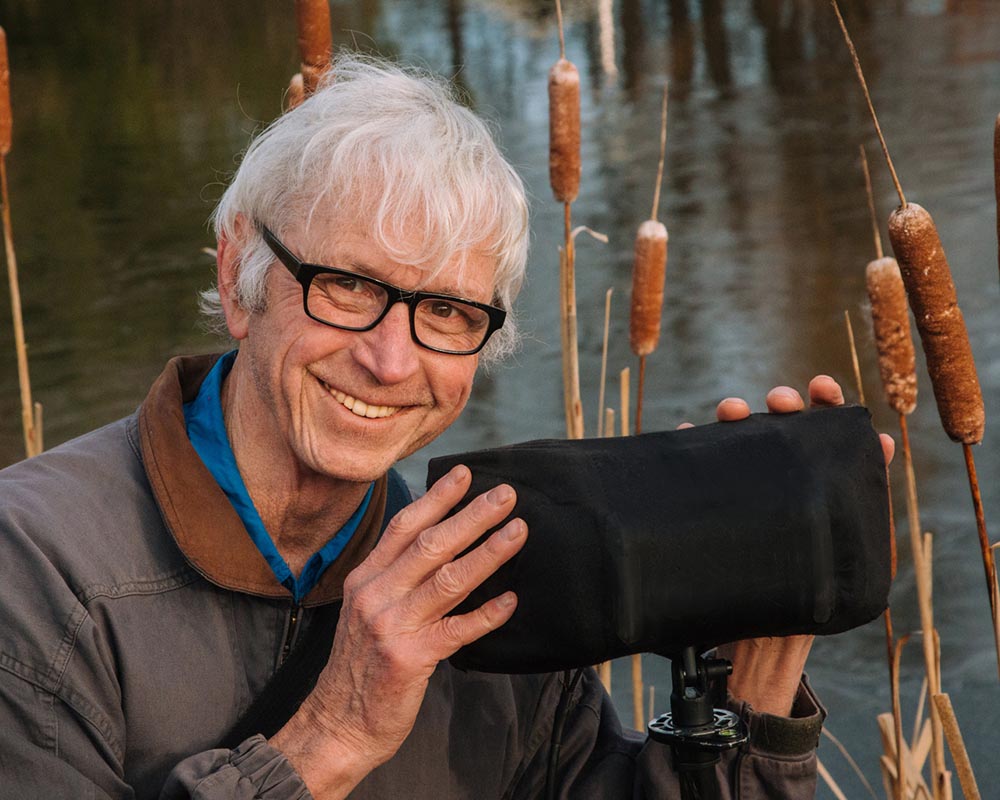
Lang Elliott
I am a professional nature recordist and the author of numerous guides to the songs and calls of our native birds, frogs, insects and mammals. Over the last 35 years I have traveled more than a half-million miles to visit wild areas across North America and beyond, with the goal of establishing a comprehensive collection of clean and clear parabolic-mic species-closeup recordings as well as spacious binaural habitat soundscapes. Through Wild Voices Extracted, I am now able to share my best work in a form well-suited for building virtual 3D nature soundscape environments using modern spatialization software.
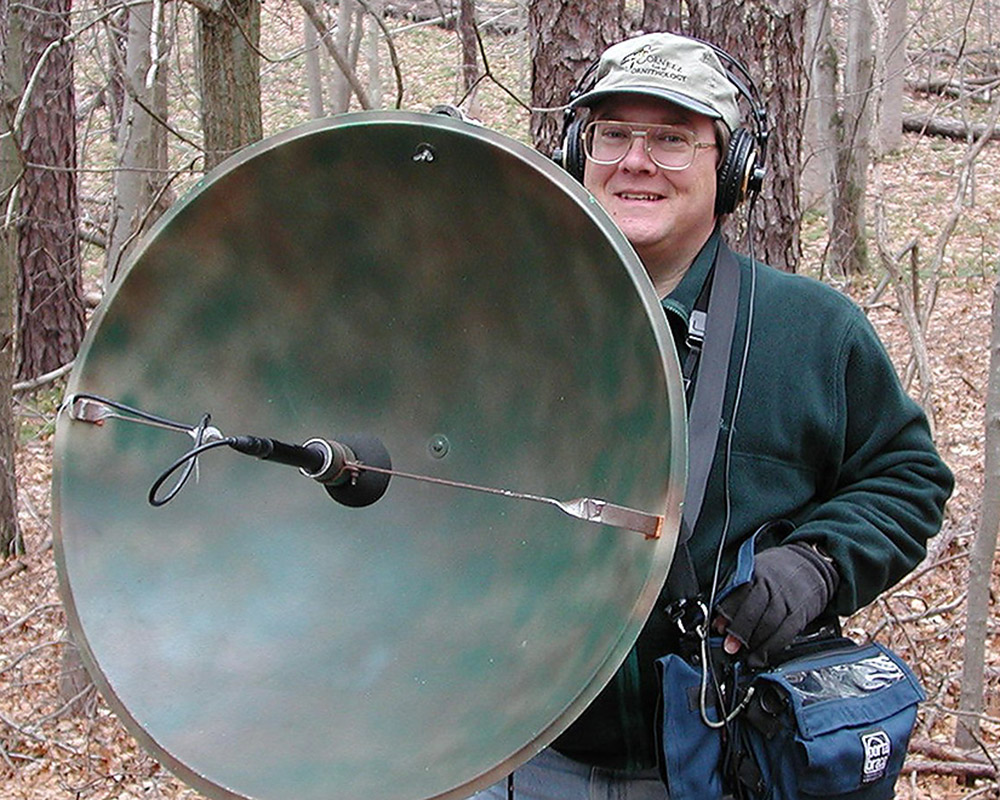
Wil Hershberger
I am a freelance nature sounds recordist with over 5,000 recordings archived at the Cornell Laboratory of Ornithology’s Macaulay Library. I co-authored The Songs of Insects and supplied images and sounds to numerous publications and websites. In addition to species-centric recordings made with a large parabola, I, too, have fallen in love with the open, spacious, binaural sounds I can capture with a soundscape microphone. From the short-grass prairies to the Rockies, from the coast of Maine to the sweltering heat of the Everglades, I have chased the elusive "perfect" recordings of our native wildlife.
Blank Tab
Product Conception
The rationale behind our creation of Wild Voices Extracted is rather simple on the surface, yet is more complex than one might initially surmise.
Nearly all field recordings of particular birds, frogs, insects and mammals contain significant background sounds, quite often the excited songs and calls of other animals in the surroundings, but also the whoosh of wind, the incessant gurgling of nearby streams, distant traffic noise, the rumble of jets, barking dogs, roosters crowing, and the like. As a result, it is often very difficult to add such recordings to ambient beds because the background sounds will be audible (unless kept at a very low level). Not only that, if the source recording is a "monaural sound object" (which is almost always desirable), the background sounds will be tightly bound to the sound object itself.
Thus, at least in the domain of adding specific monaural sound objects to virtual 3D environments, it makes good sense to process field recordings to reduce or eliminate background sounds, thus making it much easier, almost trivial in fact, to add them to surround beds at whatever level is desired. Wild Voices Extracted has quite literally "done this hard work for you," so that you can focus on creativity and not have to wrangle field recordings yourself to make them usable.
When attempting to spatialize nature sound objects, another problem inevitably comes to the fore. And this has to do with "reverberation." Nearly all object-oriented field recordings are reverberant to one degree or the other, and sometimes quite so. For instance, when an owl hoots in the wilds, the "reverberant tail" at the end of the hoot is usually quite obvious. Furthermore, if one listens closely, it is apparent that reverberation "reaches out in all directions." The echo after an owl's hoot occurs across the entire landscape; it is not bound to the owl itself.
The fact is ... reverberation occurs as the hoot radiates out into the environment and reflects off of objects, be they tree trunks, rock formations, or nearby hills. Thus, reverberation is the landscape's response to the hoot and represents a marriage of the hoot that left the owl's beak with the owl's surroundings. From the perspective of the listener, the owl's hoot does not exist all by itself as a singular sound object. Rather, it becomes intertwined with its surroundings, a true expression of the whole.
In light of the above, it should be obvious that reverberation is inherently three-dimensional and does not occur at the same location where the sound object originated. When an owl hoots, the sound object that leaves its beak is virtually free of reverberation. Reverberation occurs as the hoot moves away from its source and interacts with the surroundings. The takeaway is: monaural point-source nature sound objects optimized for placement in 3D surround environments should be dry and non-reverberant. Reverberation should be added during the spatialization process such that the reverb reaches out in all directions, thus giving life to the sound object by "marrying it" to its three-dimensional surroundings.
In conclusion, the editing techniques we have used to create Wild Voices Extracted not only involve the elimination of background sounds, but also require reduction of reverberation to dry-out the sound object and make it more suitable for subsequent spatialization and reverberation in ambient surround beds.
Spatialization Basics
Placement of sound objects in 3D audio environments is fairly straightforward. The main requirement is access to spatialization software, some of which may be platform dependent. For instance, while the popular DearVR Pro spatialization software is adaptable to a variety of surround platforms, other plugins such as the Oculus Spatializer are aimed at specific game development engines such as Unity. In add cases, however, the basic spatialization procedure is the same.
First off ... once a monaural, point-source sound object is selected, it is placed in the three-dimensional sound-field in a particular direction and at a particular distance. HRTFs (head-related transfer functions) and similar processing tricks are used to create the sense that the object is out there in space, and not inside the head of the listener. Volume, of course, must be adjusted accordingly. Note however that spatialization all by itself will not yield a natural-sounding result. Of critical importance is to add reverberation, which (as explained in "Spatialization Basics"), reaches out into space to connect the sound object to its environment.
Great care must be taken when adding reverberation, with attention paid not only to distant reverberation but also to close reflections, especially when sound objects are placed nearby. In most real world applications, however, sound objects such as owl hoots, bird songs, frog calls, and insect chirps are generally placed in the distance for a more ambient, mood-setting background effect. Thus, distant reverberation is typically more important than close reflections.
The amount and quality of the reverberation makes a huge difference and sound designers must experiment to find favorite settings that produce the desired effect. As an example, all of our binaural demonstrations (featured above) were made in Logic Pro using the DearVR Pro spatialization plugin. In most cases, we used the built-in reverberation options offered in the plugin itself and turned off the close reflection option. Only a handful of the reverb "spaces" built directly into DearVR Pro proved useful to us as we strived to produce a natural "outdoor-sounding" result (these were: Medium Recording Hall, Large Recording Hall, King's Hall, Cathedral, and Church).
Many sound designers will of course choose to use their favorite reverb plugins rather than those built into the spatializer software, and this is generally easy to implement. In DearVR Pro, one needs only to turn off the internal reverb section and then add one's chosen reverb plugin into the effects sequence right after spatialization of the sound object. In our own work, we've experimented with using Exponential Audio's Nimbus plugin instead of Dear VR Pro's on-board options, and we were able to achieve very good results. In addition, we tried using outdoor impulse responses (available from Boom Library) in conjunction with the Altiverb convolution plugin, again with satisfying results.
The sky is the limit when it comes to adding reverb. Producing a truly natural-sounding result is key to tricking the listener into believing that the sound-makers (birds, frogs, insects and mammals) are really out there in nature, fully integrated and "married to" the ambient surround bed. Fortunately, the spatialization tools currently at our disposal are remarkable in this respect, and quite capable of producing amazingly realistic results.
Our Extraction Technique (should we include?)
Although we do not intend to share all of our processing secrets, the following summarizes the basics of our workflow.
First off, we search our vast collection of field recordings for our best examples of the songs and calls of various species, attempting whenever possible to include the most common variations, dialects, etc. We prefer recordings that already have strong sound object signal levels, along with low reverberation, low background noise, and minimal wind whoosh.
We do most of our editing using Izotope RX, an industry standard tool that is amazing in its own right. However, we also employ a variety of additional plugins that improve our ability to clean up recordings.
Most of our time is spent carefully noise reducing and clearing away background sounds. Many edits are performed meticulously by hand. Almost always, we replace backgrounds with low-level smooth noise that is 60-70db down from peak signals, making the background virtually inaudible in a mix, even when sound objects are rendered loudly. This eliminates the need for fade-ins and fade-outs … sound objects can be instantly placed anywhere in the timeline without creating audible background transitions.
We employ several different plugins to help reduce reverberation, but a lot of this work must be done carefully by hand in order to avoid degrading the sound objects. Reducing reverberation can be quite tricky, especially with rapidly modulated sounds like woodpecker drums. but we have relentlessly honed our technique in order to produce sound objects that respond well when reverberation is added during spatialization.
As mentioned previously, all our final extractions are tested by spatializing them into binaural ambient beds using DearVR Pro. We summarily discard any sound objects that do not sound good in the final mix, and then work hard to improve those that pass our listening tests.

Dry And Lifeless? Don’t Be Fooled! (should we include?)
At first, extracted nature sound objects may strike one as sounding a bit strange and unsettling … dry, lifeless, and rather “unnatural.” This is not surprising because the extraction process has indeed removed the sound object from its environment, turning it into a monaural sound file, reducing its natural reverberation, and robbing it of its ambience. In a sense, the sound object has essentially been disembodied, the life has effectively been squeezed out of it. Yikes! But isn’t that the point of performing the extraction?
Don’t be fooled if you are initially unsettled by the sound. Remember that the “proof is in the pudding,” meaning the utility of a sound object is determined by what happens when the extracted version is rejuvenated by the spatialization process, when life is breathed back into it, thereby re-embodying it and intimately connecting it to its new surroundings.
Rest assured we have tested our extractions time and again by spatializing them. Once added to a surround bed, the telling question is always the same: “Does it sound natural and real, much as it did in the original field recording?” Any extracted sound objects that don’t pass this test are discarded. All others are tested yet again and then tweaked, when possible, so that they sound even better than before.
It is well to consider the following story, which sheds light on this matter:
When we began this project, we extracted an owl hoot from a spacious binaural field recording that included a loud cricket chorus. Then we asked a nature-wise friend to listen to it and compare it with the way it sounded in the original. Although familiar with the outdoors and blessed with great ears, our friend summarily concluded “It’s been noticeably changed, it’s dull and clearly different from the original … the software you used has altered it. It is not nearly as riveting as the original. You probably shouldn’t use it.”
Well, that’s not we hoped he would say. But was he right? Was the owl’s hoot actually altered so much that it became unusable? To answer this question, we ran a simple test. We used DearVR Pro to spatialize the extracted sound object and add it back into the original binaural field recording, placing it right next to the original un-extracted, un-processed hoot. Then we tweaked the reverb to match. The result was astonishing. There was very little audible difference between the two!
How telling indeed! Our friend thought the extracted hoot was significantly altered, even though it wasn’t. The complete removal of the bright insect chorus is what made it sound dull. Furthermore, the conversion from binaural to monaural effectively eliminated any sense of space. And the subsequent removal of reverberation squeezed even more life out of the hoot. Our friend thus concluded that sound object had been over-processed and altered significantly. But our remix proved that all essential elements of the hoot were indeed still intact, awaiting appropriate rejuvenation, awaiting a new breath of life.
As we proceeded with our project, we performed this test a number of times, inserting extracted sound objects back into the ambiences from which they were extracted, spatializing them and then placing them next to the original objects. In nearly all cases, the two sounded so much alike that it was hard to tell them apart, and what differences we could hear proved to be more related to differences in the character of the reverberation than they were to differences between the sound objects themselves.




Subscribe to My Newsletter
Join my mailing list to be notified when I publish new articles or blog posts.
You have Successfully Subscribed!